
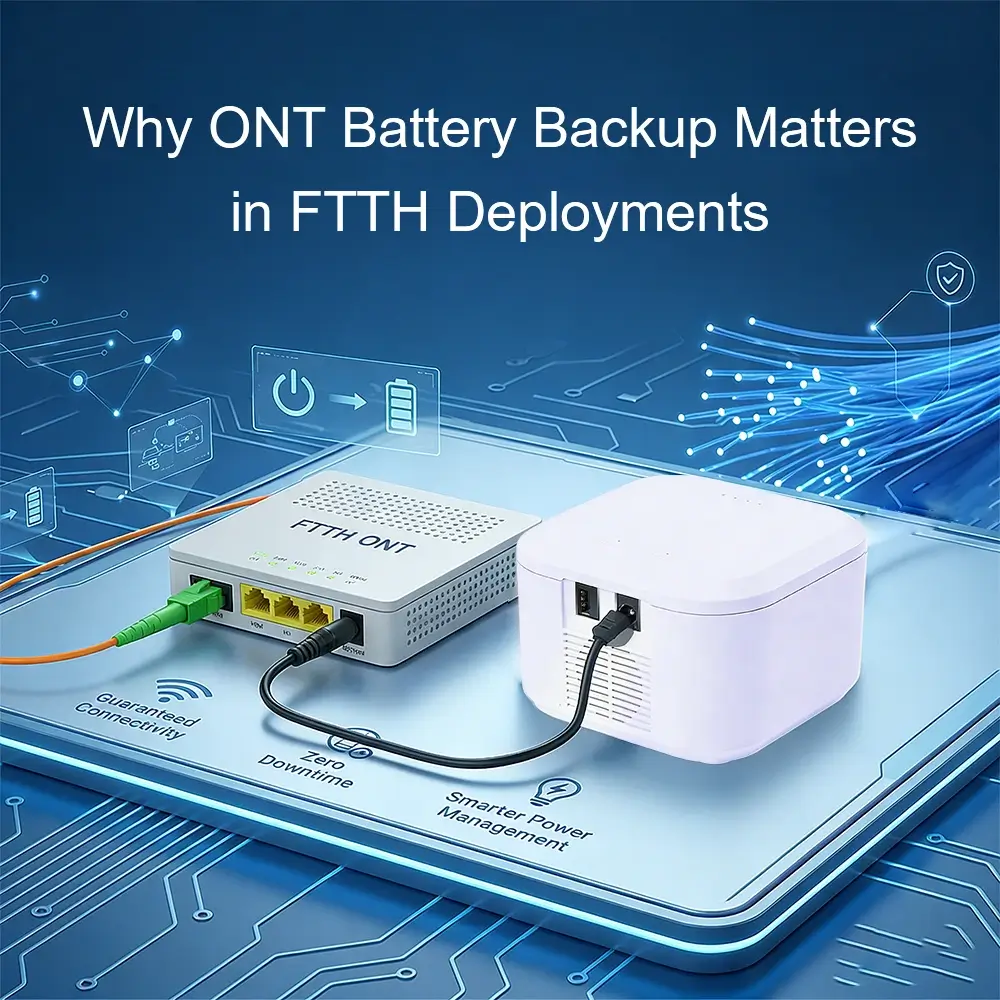
In FTTH deployments, the Optical Network Terminal (ONT) is a crucial device that converts optical signals into usable internet service within the customer’s premises. When grid power fails, the ONT often shuts down immediately, which means internet service is interrupted even if the external network remains active.
For European Chief Technology Officers (CTOs) and Procurement Directors, localized power outages are no longer merely an inconvenience—they pose a direct threat to revenue. These infrastructure failures inevitably lead to:
- A significant increase in customer support tickets.
- High on-site service costs.
- Severe penalties for violating service level agreements (SLAs).
Consequently, for telecommunications carriers, Internet service providers (ISPs), and broadband equipment procurers, integrating dedicated Mini UPS units as backup power sources for ONT batteries has become a critical strategy.
What an ONT Does in a Fiber Internet Setup
In a Fiber-to-the-Home (FTTH) architecture, the ONT serves as the critical demarcation point between the ISP’s passive optical network and the subscriber’s active local area network. It is responsible for translating light pulses traveling over fiber optic cables into electrical ethernet signals that routers and localized devices can process.
To fully grasp the vulnerability of modern fiber networks during a power outage, it is essential to compare the ONT’s architecture with legacy infrastructure:
FTTH (ONT) vs. Legacy Copper (DSL) Architecture Comparison
| Technical Architecture | Optical Network Terminal (FTTH) | Legacy Copper Networks (e.g., DSL) |
| Transmission Medium | Fiber Optic Cable (Light pulses) | Copper Wiring (Electrical signals) |
| Bandwidth Capacity | Multi-Gigabit (Symmetrical speeds) | Severely limited (Distance-dependent) |
| Inherent Power Supply | None. Transmits data only. | Line-powered. Draws low-voltage DC from the central office. |
| Grid Outage Vulnerability | Critical. Instantly drops connection without local backup power (e.g., mini UPS). | Moderate. Can often maintain basic connectivity if the central exchange is powered. |
Unlike legacy copper-based networks (like DSL), which can sometimes draw low-voltage power directly from the central office lines during a blackout, optical fiber transmits only data—no electricity. Consequently, without a dedicated backup power solution such as a Mini UPS, once the power grid fails, the high-speed advantage of optical fibers will be completely lost.
Why ONT Power Loss Causes Immediate Internet Downtime
The moment alternating current (AC) power drops at the end-user location, the ONT ceases functioning. This results in an immediate hard drop of internet protocol (IP) connectivity, voice-over-IP (VoIP) services, and critical smart home or medical monitoring systems.
For ISPs, the fallout from this power loss is measured in direct financial drain:
- Support Ticket Tsunamis:Even a 5-minute brownout generates thousands of “No Internet” calls to Tier 1 support, overwhelming call centers.
- SLA Non-Compliance:Localized power failures that drop the ONT still count against the ISP’s uptime metrics, triggering automatic financial rebates.
- Customer Churn:In highly competitive European broadband markets (e.g., regions dominated by Vodafone, T-Mobile, or local fiber challengers), perceived unreliability is the leading cause of subscriber migration.
Common Backup Power Options for ONT Devices
To address power grid instability, a variety of backup power solutions have emerged. However, not all backup power solutions are suitable for ONT devices.
ONT Equipment Backup Power Comparison
| Solution Type | Energy Efficiency | Space / Form Factor | TCO & Maintenance | Deployment Suitability for FTTH |
| Legacy AC UPS | Low (Heavy AC/DC double conversion loss) | Bulky, requires floor/desk space | High (Lead-acid batteries require frequent replacement) | Poor (Overkill, poor aesthetic for residential/SMB) |
| Proprietary BBU | Medium | Medium (Often requires wall mounting) | Very High (Vendor lock-in on replacement cells) | Moderate (Usually restricted to specific ONT brands) |
| Mini DC UPS (e.g., Mylion) | Optimal (Direct DC-DC transmission, zero conversion loss) | Minimal (Zero-U, easily integrates into utility boxes) | Lowest (Extended lithium lifespan, maintenance-free) | Excellent (Universal plug-and-play architecture) |
Benefits of Mini UPS for FTTH Rollout Projects
Deploying a dedicated Mini DC UPS specifically engineered for telecom equipment fundamentally shifts the ISP’s operational expenditure (OpEx) model. By bypassing the inefficient AC-to-DC conversion process found in traditional UPS units, a Direct Current (DC) UPS provides uninterrupted, seamless power (0ms transfer time) directly to the ONT.
When Internet Service Providers (ISPs) use Mini UPS as the ideal backup power solution for ONTs, the key benefits are as follows:
Optimized Capital Expenditures (CapEx): Deploying small uninterruptible power supplies (UPS) at the customer premises is more cost-effective than deploying redundant systems at the grid level.
- Zero Downtime (0 ms transmission time): True 0-millisecond switching ensures that data streams, VoIP, and smart home systems remain online during power grid fluctuations.
- Compact Design and Easy Deployment: The compact, plug-and-play design fits easily into tight residential electrical panels. No complex installation or on-site maintenance is required.
- Reliable Uptime: The Mini UPS uses high-quality lithium-ion batteries to continuously power high-performance gateways during power outages.
Key Technical Points: Voltage, Runtime and Connector Compatibility
When specifying a Mini DC UPS for large-scale FTTH procurement, key technical points cannot be ignored. These include voltage, operating time, and connector compatibility.
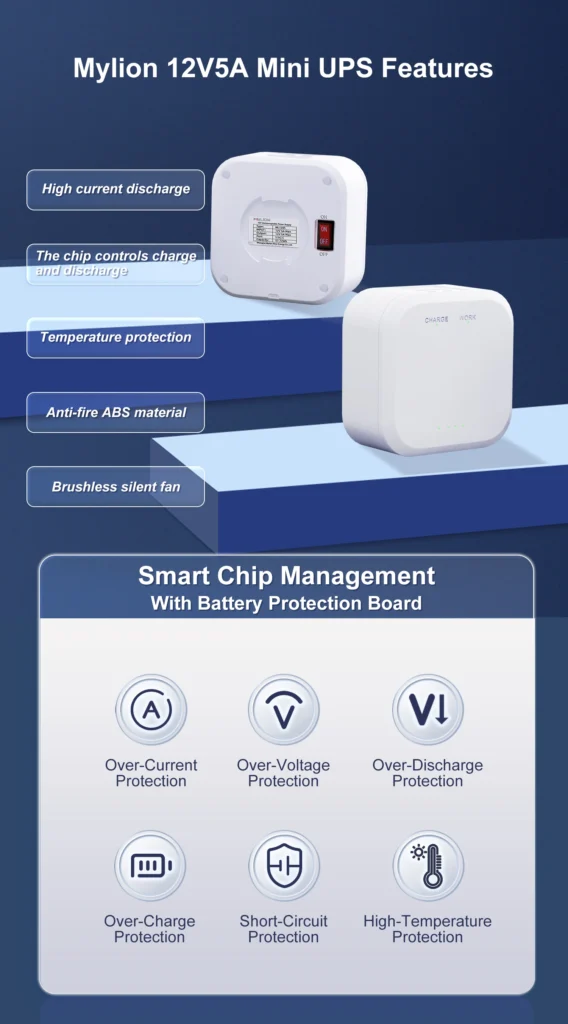
The Mylion MU35 Mini UPS is specifically designed to meet these high-demand scenarios. Its features include:
- Input/Output Precision: 12V input, 12V 5A maximum output, suitable for ONT devices with high energy consumption. The 5A current output prevents voltage drop in ONT under high data load.
- Extended Operating Time: Utilizes high-quality lithium batteries and is managed by an advanced battery management system (BMS) to ensure several hours of continuous backup power during alternate power outages.
- Universal Connector Compatibility: The MU35 Mini UPS is compatible with various devices, including ONT/ONU, Wi-Fi routers.
How Telecom Buyers Evaluate ONT Battery Backup Solutions
For European telecom procurement directors and chief technology officers, selecting an Optical Network Terminal (ONT) battery backup partner involves much more than just basic specifications. The following metrics must also be evaluated:
- Technology and Lifespan
A high-quality ONT battery backup solution should meet several stringent requirements:
- Utilize advanced battery chemistry
- Be equipped with an intelligent Battery Management System (BMS)
- Deliver a long service life
- Longer Mean Time Between Failures (MTBF)
This is critical for preventing premature hardware degradation and ensuring long-term compliance with Service Level Agreements (SLAs).
- Total Cost of Ownership (TCO)
Beyond the initial capital expenditure (CapEx) for equipment, the true cost of a backup power solution lies in ongoing maintenance. An excellent solution must offer the following:
- Significantly reduced logistics and warehousing costs for replacement parts
- Minimal or no maintenance requirements
- Lower SLA penalties
These cost reductions fundamentally transform the operational cost model, thereby maximizing return on investment (ROI) across the entire network.
- Environmental Reliability
Fiber-to-the-Home (FTTH) equipment is typically deployed in environments with significant temperature fluctuations. A reliable backup solution must operate flawlessly in the following environments:
- Non-climate-controlled outdoor distribution cabinets.
- Dusty or humid local distribution centers.
- Poorly ventilated enclosed utility rooms or basements.
- Extreme seasonal weather conditions (from freezing cold to scorching heat).
This ensures a continuous and stable power supply without performance limitations, rapid degradation, or fire hazards, regardless of the physical environment.
- Compact Design
Space is extremely limited at the customer’s point of connection. To enable seamless deployment, the backup power solution must be space-efficient, as evidenced by:
- A compact form factor that does not require dedicated cabinet space.
- Universal compatibility that allows for easy integration into standard compact wall-mounted enclosures.
- A plug-and-play design that requires no complex setup.
- A clean, weatherproof enclosure suitable for installation in prominent locations.
These design features ensure rapid adoption without compromising the high-quality aesthetic required by high-end residential properties or small and medium-sized businesses (SMBs).
Mylion’s Advantages: Designed for FTTH Edge Continuity
As a leading provider of lithium-ion battery solutions, Mylion has specifically designed its Mini DC UPS product line to address the challenges faced by European Internet Service Providers (ISPs) during deployment. Securing the network edge with absolute industrial-grade reliability:
Next-generation technology and extended lifespan: Mylion utilizes advanced lithium-ion batteries with strict, proprietary BMS control. This ensures rigorous overcharge and over-discharge protection, resulting in a longer service life.
Achieving 0-millisecond transmission latency: By deploying a maintenance-free architecture that truly achieves 0-millisecond transmission latency, Internet Service Providers (ISPs) can significantly reduce operational expenses (OpEx).
Industrial-Grade Environmental Reliability: The Mylion MU35 Mini UPS guarantees a stable 12V DC 5A Max (60W) output. It ensures an uninterrupted power supply to high-demand Optical Network Terminals (ONTs) even under extreme weather conditions or grid fluctuations.
Ultra-compact, zero-interference design: The MU35 Mini UPS is specifically designed for modern Fiber-to-the-Home (FTTH) environments and features a plug-and-play form factor. It can be easily installed inside standard user telecom enclosures without complex installation procedures.
FAQ
Q1: Will a mini DC UPS introduce latency in an optical network?
No. A high-quality mini DC UPS like the MU35 operates entirely at the power transmission layer, with a switching time of 0 milliseconds. It has no impact on fiber data transmission speeds or latency.
Q2: Can the Mylion MU35 power both an Optical Network Terminal (ONT) and a high-performance router simultaneously?
Yes. The MU35 features a robust 12V DC output with a maximum of 5A. As long as the total power consumption does not exceed its maximum rating, it can provide sufficient power to multiple edge devices via an appropriate power distributor.
Q3: How does deploying Optical Network Terminal (ONT) backup affect customer retention for Internet Service Providers (ISPs)?
By decoupling internet reliability from the local power grid, ISPs can protect users from the effects of micro-outages. This directly reduces customer churn in a saturated broadband market.
Q4: Can MU35 users install it themselves, or does it require a technician?
The MU35 is fully plug-and-play and requires no configuration. Users simply connect it in series between the wall adapter and the Optical Network Terminal (ONT) to complete the installation in seconds.
Q5: Are there any safety or compliance risks associated with deploying a lithium-ion UPS in a residential setting?
The MU35 is equipped with an advanced Battery Management System (BMS). It strictly complies with CE and RoHS standards, ensuring absolute safety in indoor, enclosed residential, or small and medium-sized business environments.
Conclusion
The era of accepting network outages caused by power grid failures is over. For Internet service providers and telecommunications operators in Europe, leaving optical network terminals (ONTs) exposed to local power fluctuations is tantamount to directly causing breaches of service level agreements (SLAs) and customer churn.
By integrating the Mylion MU35 Mini UPS into your FTTH deployment, you can immediately protect the most vulnerable points in your network. Secure the edge of your infrastructure and ensure that local power grid fluctuations no longer compromise your network’s reliability.
 English
  简体中文
简体中文  Deutsch
  Français
  Italiano
  Español