
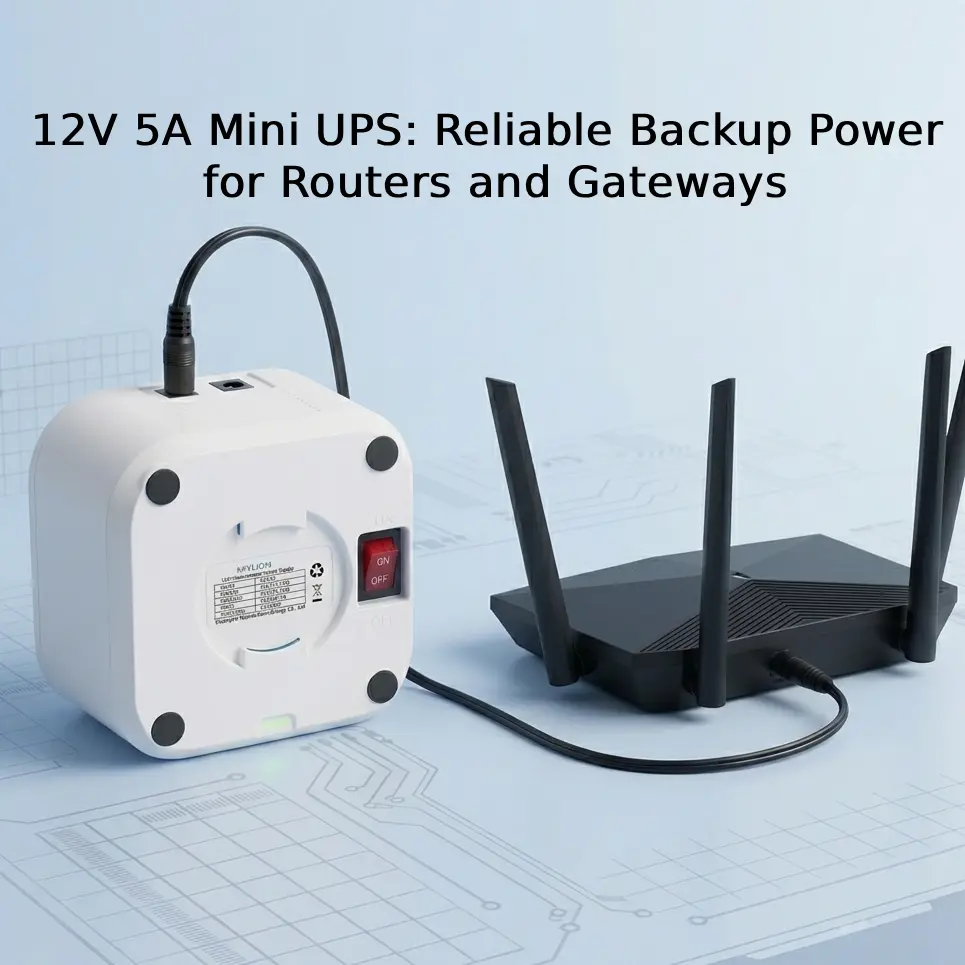
In broadband and telecom backup projects, not all devices have the same power demand. Some standard ONT devices can be supported by compact, low-current mini UPS solutions. However, when the application involves higher-power routers, gateways, or dual-device backup, a 12V 5A mini UPS is often the more professional and reliable choice.
A 12V 5A mini UPS is a backup power solution designed for higher output capability, greater load margin, and broader compatibility. For B2B customers seeking to maintain network continuity during power outages, the 12V 5A specification has become a crucial component.
Why Router and Gateway Backup Matters
In many FTTH, broadband, and telecom network deployments, the router or gateway is just as important as the ONT. If the ONT stays powered but the router goes down, users still lose Wi-Fi, LAN services, and internet connectivity.
For ISPs and system integrators, providing a stable, reliable backup solution for higher-power CPE devices bring the following benefits:
- maintain broader service continuity during outages
- reduce end-user complaints
- lower support pressure
- improve service reliability perception
- support more complete backup deployment packages
In these cases, selecting the right output current becomes more important than simply choosing the smallest or cheapest backup unit.
Why 12V 3A Is a Common Choice for ONT Backup
Many routers, gateways, and combined network device setups draw more power than a typical ONT-only application.That makes 12V 5A Mini UPS solutions a practical choice in cases such as:
- higher-power router backup
- gateway backup
- ONT plus router backup
- dual-device backup
- devices with higher startup current
- projects that need more load margin in field conditions
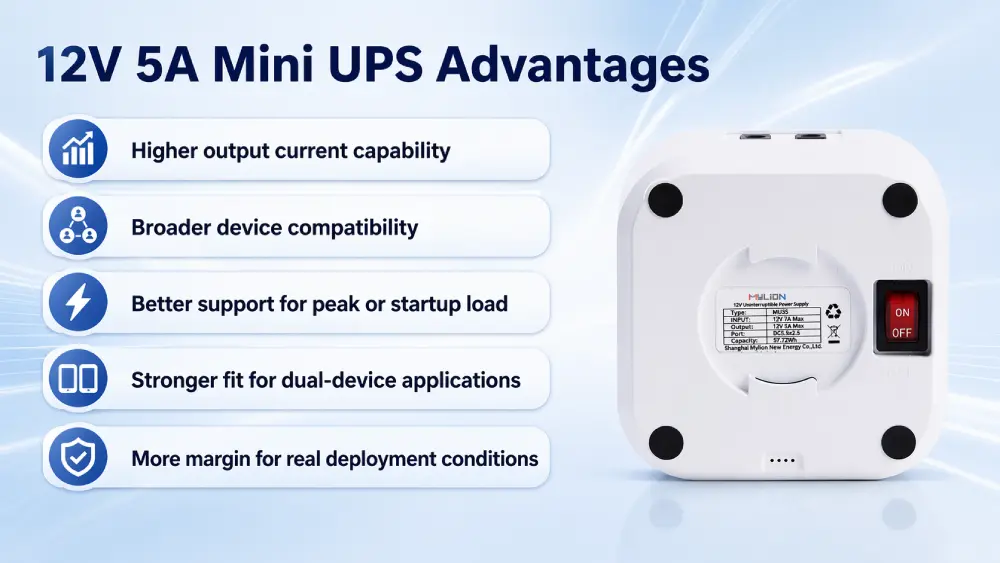
The main advantages are:
- higher output current capability
- broader device compatibility
- better support for peak or startup load
- stronger fit for dual-device applications
- more margin for real deployment conditions
In short, 12V 5A is often selected when the backup requirement goes beyond a basic single-device scenario.
When a 12V 5A Mini UPS Is Usually Suitable
A 12V 5A Mini UPS is usually suitable when the project involves:
- router backup with higher current demand
- gateway backup
- dual-device backup such as ONT plus router
- applications with uncertain or fluctuating load
- projects requiring stronger compatibility across multiple device types
- deployment conditions where extra current margin improves reliability
Common examples: backup for high-end broadband devices, enterprise routers/gateways, projects requiring Wi-Fi continuity during outages, integrated FTTH equipment deployments, and single UPS support for multiple devices.
When a 12V 5A Mini UPS may not be necessary:
- Low-power ONT only
- Single device with very low load
- Space and cost are the primary constraints
- No need for a large current margin
In these cases, a 12V 3A mini UPS may be sufficient and more cost-effective. Good product selection is not about blindly choosing the most powerful model, but matching the actual device and project requirements.
How to Evaluate a 12V 5A Mini UPS Properly
Before selecting a 12V 5A Mini UPS for router or gateway backup, buyers should confirm:
- Device Voltage: Check that the device requires 12V DC input.
- Actual Operating Current: Estimate the real operating current, not only the adapter label if better data is available.
- Startup or Peak Current:Some routers and gateways draw higher current during startup or temporary load peaks. This is a common reason why undersized solutions fail in the field.
- Single Device or Dual Device: Confirm whether the Mini UPS supports one router only, one gateway, or an ONT plus router combination.
- Backup Time Target: Define the expected runtime clearly.Even if output current is sufficient, battery capacity must still match the runtime goal.
- Connector and Adapter Compatibility:Check connector size, polarity, and adapter matching carefully.
- Deployment Consistency:For ISP and integrator projects, stable batch quality matters as much as the initial sample result.

Typical Use Cases for 12V 5A Mini UPS
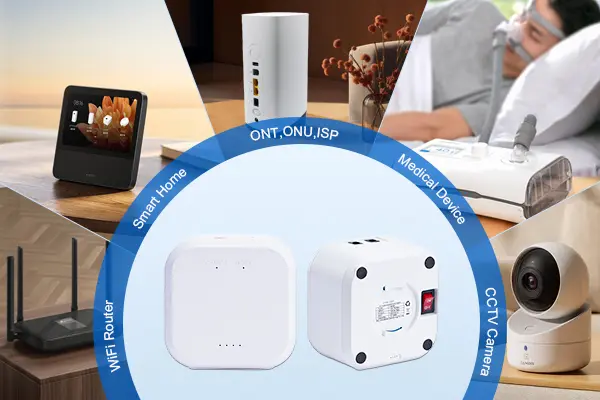
In real-world broadband and telecom projects, the 12V 5A mini UPS is widely used in the following typical scenarios thanks to its output current capability and power margin.
1. High-Load Router Backup
For example, an ISP using the MYLION MU35 Mini UPS for SMB router backup reported stable full-speed operation under 12V 5A output.
2. Gateway and High-Load Edge Device Backup
Gateways often integrate routing, security, NAT, and other functions. Their SoC or x86-based architecture can have high power consumption, with inrush current reaching 3A–4A at startup.
A 12V 3A UPS may trigger overcurrent protection or voltage drop during startup, causing repeated reboots. The 12V 5A MYLION MU65 Mini UPS specification provides ample startup margin to ensure a successful boot every time.
3. ONT + Router Dual-Device Powering
In FTTH scenarios, users typically have both an ONT and a separate router. Providing a separate UPS for each device significantly increases cost and installation complexity. A 12V 5A mini UPS can power both devices simultaneously – provided the total steady-state current does not exceed 4A and peak current stays below 5A.
For example, a typical ONT draws about 0.5A–1A, and a mid-to-high-end router draws about 1.5A–2.5A. The total is around 3A, well within the capacity of the MU05 Mini UPS or MU35Mini UPS, leaving a 2A margin for startup transients.
4. Network Devices with High Inrush Current
Some routers or gateways come with a 12V 3A switching adapter, but the actual inrush current at startup can reach 5A or more (especially when internal capacitors or a mechanical HDD are present).
If the UPS output current is limited to 3A, the device may fail to start. A 12V 5A UPS solves this compatibility problem with its higher instantaneous current capability.
5. Deployments Requiring Extra Output Margin
In real-world environments such as outdoor cabinets, wiring closets, or long DC cables, line voltage drop and temperature variations can reduce the voltage actually delivered to the device.
MU35 Mini UPS with 5A output capability provides more stable voltage regulation and greater current margin, improving long-term field reliability. Many integrators have already set 12V 5A as the minimum requirement for FTTH bulk deployments to reduce maintenance costs.
How MYLION Supports 12V 5A Router and Gateway Backup
MYLION is committed to providing professional and reliable mini UPS solutions for telecom and ISP customers. For 12V 5A router, gateway, and higher-load broadband backup needs, we offer three core models – MU35, MU65, and MU05 – each designed for different load currents, backup durations, and deployment scenarios.
Product Comparison Table: MU35 vs MU65 vs MU05
Feature | MU35 Mini UPS | MU65 Mini UPS | MU05 Mini UPS |
Rated output | 12V 5A (continuous) | 12V 5A (continuous) | 12V 5A (continuous) |
Battery capacity | 77.7Wh | 57.72Wh | 44.4Wh |
Battery type | Lithium ion | Lithium ion | Lithium ion |
Typical backup time | ~7 hours | ~5 hours | ~3 hours |
Number of output ports | 2 | 1 | 1 |
Application scenarios | • High-power router/gateway backup | • Enterprise gateway equipment | • High-power device |
MYLION's B2B Service Advantages
Beyond product performance, MYLION provides telecom operators, ISPs, and integrators with:
- Customisation:Connector type, cable length, battery capacity, and housing colour can be tailored to project requirements.
- Batch consistency: Every batch undergoes burn in testing and sample inspection to ensure field failure rate below 0.2%.
- Technical selection support:Based on your device models, measured currents, and target backup time, we provide precise matching recommendations – not just the largest model.
- Fast delivery: For standard models like MU35, MU65, and MU05, we maintain stock and support small batch samples as well as large volume orders.
FAQ
Q1: Is a 12V 5A mini UPS suitable for router backup?
Q2: Can one 12V 5A UPS power both an ONT and a router?
Q3: Does a 12V 5A UPS always provide longer backup time than a 12V 3A UPS?
Q4: Why is 12V 5A more recommended for gateway backup?
Q5: Is 12V 5A always better than 12V 3A?
Q6: What should buyers check when selecting a 12V 5A mini UPS?
Conclusion
The 12V 5A mini UPS is a very practical solution for router, gateway, and dual-device backup scenarios, especially when projects require higher current support, greater startup margin, and broader device compatibility. However, it is not the best choice for every 12V device – correct selection should be based on actual device load, startup behaviour, backup time objectives, and deployment environment.
For broadband, telecom, and system integration projects, the ideal 12V 5A mini UPS solution should precisely match the real service continuity requirements. MYLION’s MU35, MU65, and MU05 product series, combined with professional B2B technical support, help you find the most suitable backup solution.

 English
  简体中文
简体中文  Deutsch
  Français
  Italiano
  Español