
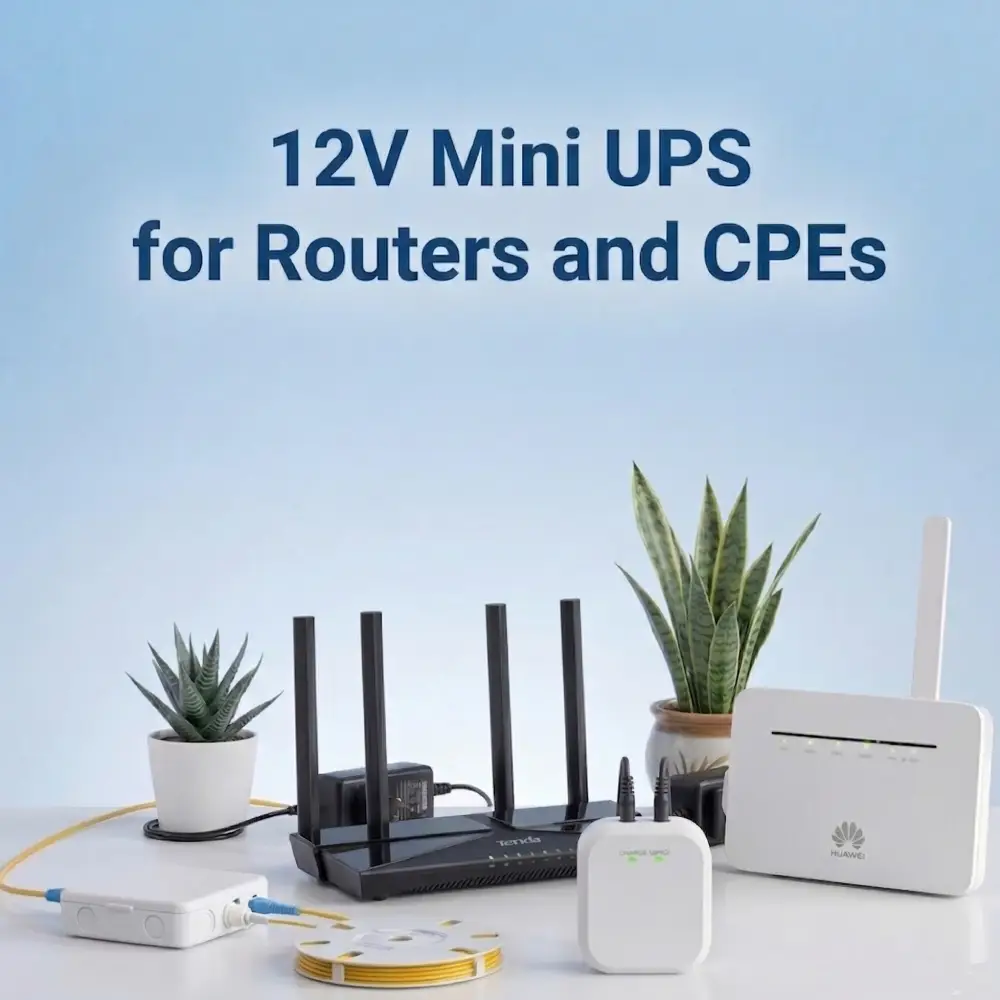
A 12V Mini UPS for router and CPE applications can help keep broadband and network equipment operating during power interruptions, but choosing the right model requires more than simply matching the 12V output.
For Telcos and ISPs, the Mini UPS must also match the device load, connector and polarity, required backup time, charging conditions and actual deployment environment.
Many routers, modems, ONTs and CPE devices use 12V DC power, making a 12V Mini UPS a practical backup option for many network applications. However, not every 12V UPS is suitable for every router or CPE.
This guide explains what to check before selecting a 12V Mini UPS for a router, CPE, ONT or modem project.
Quick Answer: How Do You Choose a 12V Mini UPS for a Router or CPE?
To choose a 12V Mini UPS for a router or CPE, first confirm that the target device requires 12V input. Then check its normal and peak power demand, connector and polarity, required backup time and charging conditions.
For ISP, telecom or OEM projects, the Mini UPS should be tested with the actual router, CPE, ONT or modem before volume deployment.
Why 12V is common in router and CPE applications
The widespread use of 12V DC voltage in network equipment is no coincidence. This voltage standard strikes a perfect balance between efficiency and safety. Unlike high-voltage AC systems that require large transformers, 12V DC voltage enables compact power adapters and efficient power regulation.
Most routers, fiber ONTs (Optical Network Terminals), and wireless CPEs (Customer Premises Equipment) are equipped with internal DC-DC converters capable of stepping down the 12V supply to the lower voltages required by the chipset (such as 3.3 volts or 5 volts). For B2B buyers and infrastructure providers, the 12V standard simplifies backup power architectures.
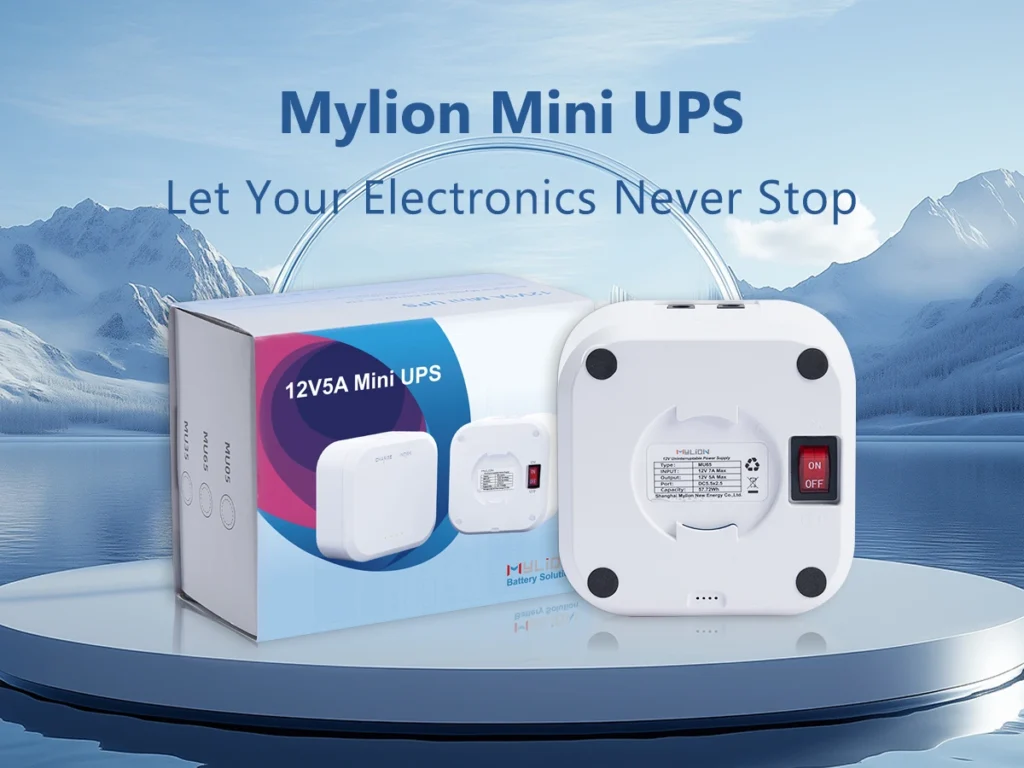
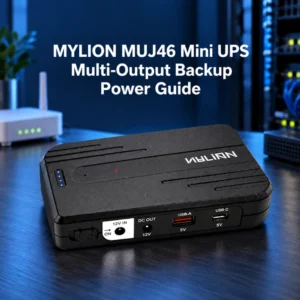
Compared to bulky AC UPS systems, a Mini 12V 5A DC UPS like the Mylion MU35 provide a direct DC-to-DC path. For backup power solutions, this can improve efficiency by up to 25% and extend battery life.
How to Choose the Right Size 12V Mini UPS for a Router or CPE
Choosing the right size 12V Mini UPS for a router or CPE starts with the device voltage and actual power demand. A 12V device should be matched with a compatible 12V output, while the Mini UPS continuous output capability must support the normal operating load and relevant peak demand.
The current rating printed on a router or modem power adapter is an important reference, but it may not represent the device’s actual operating consumption. For business-critical projects, measuring the real load provides a stronger basis for Mini UPS selection.
If one Mini UPS will power multiple devices, such as an ONT and router, evaluate the combined system load rather than selecting the UPS from one device alone.
Input and output specifications that matter
When evaluating a 12V Mini UPS, the most frequent point of failure in procurement is a mismatch between the UPS output capability and the device’s peak demand.
The Importance of “Immediate Switching”
A router is a sensitive computer. Even a millisecond drop in voltage can cause a CPU reset, leading to a 2-5 minute reboot cycle for the internet connection. High-quality Mini UPS units feature Zero-Transfer Time technology.
The Mylion MU35 utilizes an internal bypass circuit that ensures the 12V 5A DC output remains rock-solid the instant the AC mains fail.
Voltage Regulation
Cheap UPS units often see their voltage drop as the battery drains (e.g., falling to 10.5V). This can cause hardware instability or “brownout” damage to the router. A professional-grade 12V UPS must maintain a regulated output within a ±5% tolerance until the battery protection circuit cuts in.
How to check current load and peak demand
The “Ampere” (A) rating is the most critical metric for hardware longevity. While many standard routers only require 1A or 1.5A, modern high-performance Wi-Fi 6/7 routers and G.PON OLTs often have significant peak power draws during boot-up or high data throughput.
Comparison: Different Output Currents and Application Suitability
UPS Output Rating | Typical Application | Applicability |
12V 1A | Basic Modems / Simple VoIP adapters | Will overheat or shut down if used with Dual-band routers. |
12V 2A | Standard Dual-band Wi-Fi 5 Routers | Sufficient for most home users. |
12V 3A | High-power Wi-Fi 6 Routers / Small Switches | Good balance. |
12V 5A | Enterprise CPE / Wi-Fi 7 / Multiple Devices | Maximum stability. |
To determine your needs:
- Check the original adapter: Look for the “Output” rating (e.g., 12V 1.5A). The UPS must be able to supply at least that amount continuously.
- Calculate total load: If the UPS is powering a router, a CPE, and a fiber modem, add the amperage of all devices.
- Account for peaks: Choose a UPS with a maximum output current at least 20% higher than your calculated total. For example, if your total load is 2A, select a UPS rated for 2.5A or 3A. Overloading the UPS can trigger thermal shutdown or damage the internal battery pack.
The 12V 5A output of Mylion MU35 is a “future-oriented” specification. By providing a potential power of 60 watts, it ensures that even if the consumption of the CPE device suddenly increases during firmware updates or high traffic periods, the UPS will not trigger overcurrent protection and shut down.
Battery capacity and expected runtime
B2B buyers often confuse “battery capacity” (mAh) with “energy content” (Wh). Since we are dealing with a 12-volt system, watt-hours is usually a more reliable measurement standard as it takes into account the voltage factor.
To calculate the running time:
- Formula: (Battery capacity (watt-hours)) / (Device load (watts)) = Estimated running time.
- Example: A 12-volt router with a power of 12 watts (1 ampere), paired with a 60-watt-hour uninterruptible power supply, theoretically should be able to run for 5 hours.
However, buyers should be aware of the issue of efficiency loss. DC-DC conversion usually has a high efficiency (85% – 95%), but the battery management system will have some losses. When reviewing the specifications, attention should be paid to the actual operating time tests rather than theoretical calculations.
Typical Mini DC UPS Models and Backup Times
UPS Model | Backup Time (Hours) | Recommended Usage |
2–6 | Home router only | |
3–8 | Router + small CPE | |
6–12 | Router + ONT | |
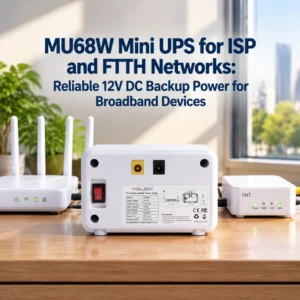
MU68 Mini UPS | 6–10 | Areas with frequent power outages |
MU248 Mini UPS | 8–24 | CCTV / small base station |
For projects that require more than 8 hours of backup time, it is advisable to consider equipment that supports external battery expansion or higher-capacity lithium iron phosphate (LiFePO4) batteries, as their cycle life is longer than that of standard lithium-ion batteries.
Safety, certification and project requirements
For procurement managers at internet service providers, safety is a matter of responsibility. Deploying tens of thousands of uncertified lithium-ion battery devices into users’ homes poses a significant risk.
Key certifications to verify:
- CE / FCC / RoHS: Basic standards for electronic products entering the EU and U.S. markets.
- 3: Critical for air transport and logistics safety.
- UL/ETL (or equivalent certification): This mark indicates that the product has undergone rigorous safety testing.
- MSDS: Material Safety Data Sheets required for warehouse compliance.
- Battery Management System (BMS): Ensures the device is equipped with overcharge, over-discharge, and short-circuit protection.
The MYlion MU35 12V Mini UPS features overcharge protection, over-discharge protection, short-circuit protection, and temperature control.
OEM and customization considerations for B2B buyers
Off-the-shelf solutions often do not fully meet the needs of complex projects. For system integrators, internet service providers, and OEM buyers, the ability to customize is key.
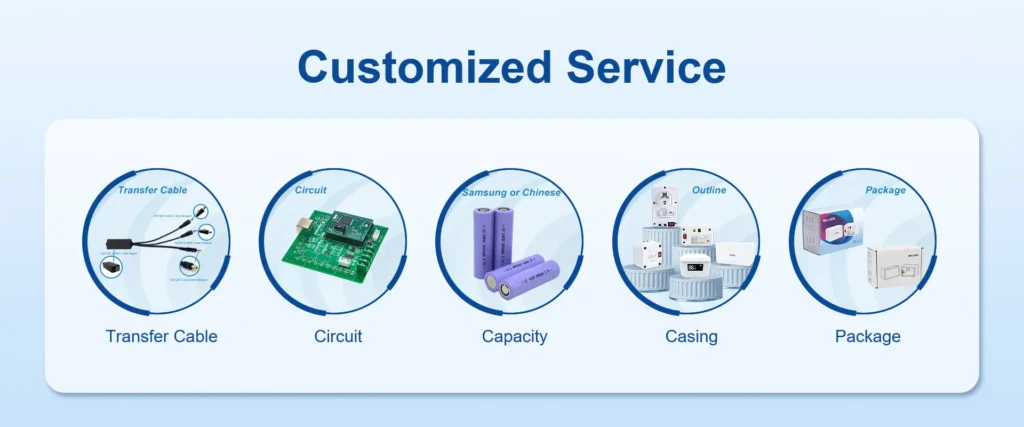
Mylion offers B2B buyers OEM logo printing, custom packaging design, and voltage/capacity customization services. When purchasing UPS units in bulk, please consider the following customization options:
- Battery chemistry: You can choose between lithium-ion batteries (suitable for compact devices) or lithium iron phosphate batteries (offering longer service life and higher safety).
- Connector Wiring: Pre-wired cables with specific socket sizes, terminal blocks, or even Power over Ethernet (PoE) output ports can significantly reduce installation time.
- Branding and Packaging: For B2B distributors, private labeling (i.e., the OEM model) helps you establish brand authority and build customer loyalty.
- Dimensions: Most Mini UPS units feature a compact design intended for installation inside structured cabling cabinets or behind small home office desks without taking up excessive space.
Mylion offers flexible OEM/ODM services to ensure that backup power solutions integrate seamlessly with your systems without the need for any workarounds.
FAQ
Q1: What is a 12V Mini UPS for router and CPE?
Q2. How do I choose a 12V Mini UPS for my router?
Q3. Can I power a 9V router with a 12V Mini UPS?
Q4. Can a 12V mini UPS power both a router and a CPE simultaneously?
Q5. Is the 12V Mini UPS for Router and CPE compatible with all broadband brands?
Q6. How long will a 12V mini UPS run my equipment?
Conclusion
Choosing a 12V Mini UPS for routers and CPE applications is a technical decision that can affect the reliability of the network and customer satisfaction. For enterprise procurement, the current load current (amps), the reliability of the conversion, and safety certification must be given priority consideration.
In the 12V 5A category, the Mylion MU35 Mini UPS stands out. With its compact industrial-grade casing, it offers high current output and solves the critical problem for Internet service providers – avoiding service calls and hardware replacements caused by poor power quality.
 English
  简体中文
简体中文  Deutsch
  Français
  Italiano
  Español