
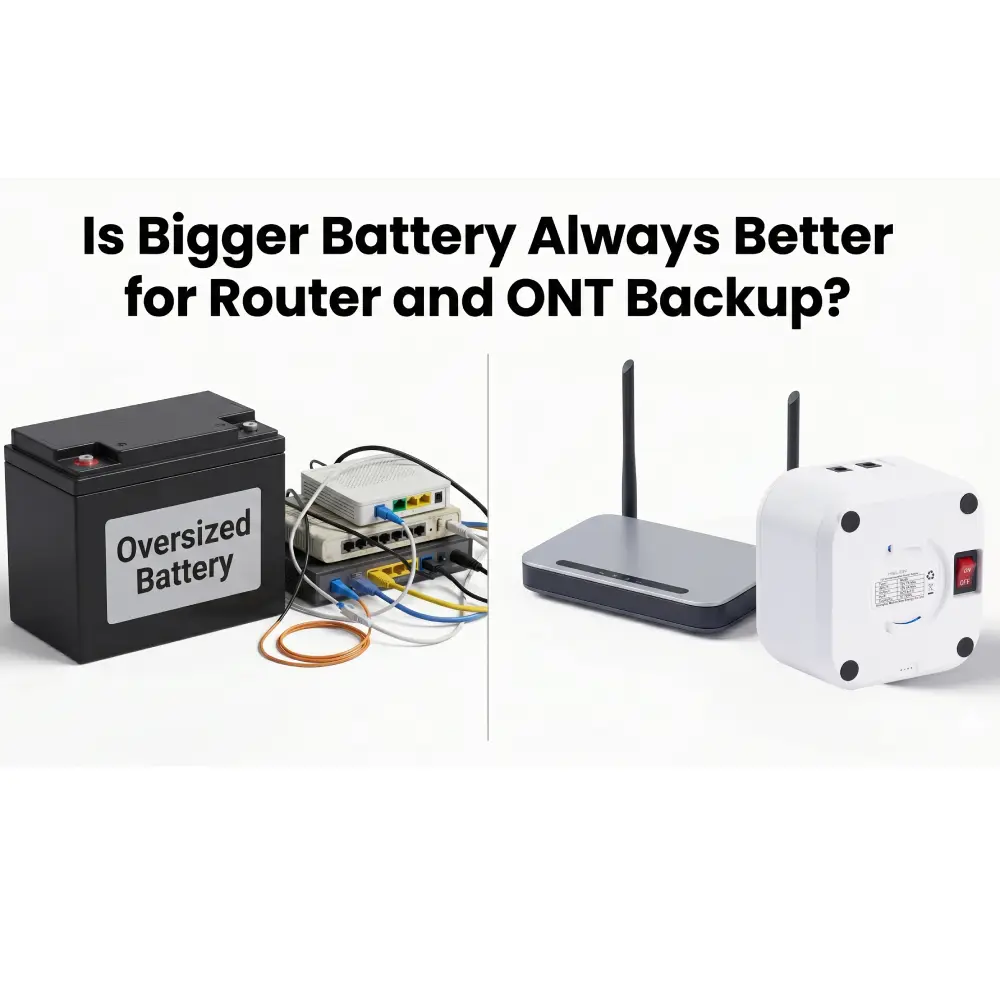
Telecom companies and ISPs often default to large backup batteries for customer-premise ONTs, routers, and outdoor network nodes. The logic seems sound: longer runtime prevents customer churn during extended outages. But for a typical last-mile deployment, oversized batteries create more problems than they solve – higher CAPEX, bulky enclosures, safety risks, and unnecessary battery swaps every few years.
For ISPs, the real goal is reliable, just–enough backup at the lowest total cost of ownership (TCO) across thousands of sites. The Mylion Mini DC UPS solutions can achieve this function without the need for large batteries, thus avoiding the increase in related costs.
Understanding ONT & CPE Power Draw – Why Capacity Guessing Fails
A standard ONT consumes 5–10W, while a Wi‑Fi 6 router typically uses 10–15W. Most customer setups draw 8–12W total. Outdoor CPEs (LTE/5G) run slightly higher at 10–15W. Raw mAh ratings mean nothing without voltage.
Real runtime formula:
Wh = mAh × Voltage / 1000 → then Wh ÷ load watts × 0.9 (efficiency)
Example: A “20,000 mAh” power bank (3.7V) provides ~74 Wh. For a 10W ONT+router, that’s roughly 6.6 hours of runtime. But ISP outage data shows that 95% of grid interruptions last under 2 hours. A 24-hour backup is overkill for typical B2B edge sites.
Three Risks ISPs Face with Oversized Batteries
1. Safety & Compliance Across Thousands of Units
Large lithium batteries generate more heat and require stricter certifications (UL, IEC 62133, UN38.3). When ISPs deploy tens of thousands of units, a single thermal event in a customer’s home or an outdoor cabinet becomes a reputation and liability disaster.
Mylion Mini UPS integrates intelligent BMS (over-voltage, over-current, short-circuit, temperature protection) and flame-retardant ABS – certified for global ISP use.
2. TCO Spiral – Purchase, Logistics, Replacement
For an ISP managing 50,000 customer sites, every extra 5 in battery cost adds 250,000 to CAPEX. Oversized batteries are heavier and larger, increasing shipping costs and warehouse space. They also need replacement every 3–5
A properly sized Mylion Mini UPS (e.g., MU48 Mini UPS with 29.6Wh) cuts upfront cost by 30–50% compared to generic large batteries, while still covering 90% of outages.
3. Deployment Constraints in Outdoor & Indoor Enclosures
ISP field engineers must fit batteries into existing demarcation boxes, outdoor OLT cabinets, and small wall-mount enclosures. Oversized batteries simply won’t fit.
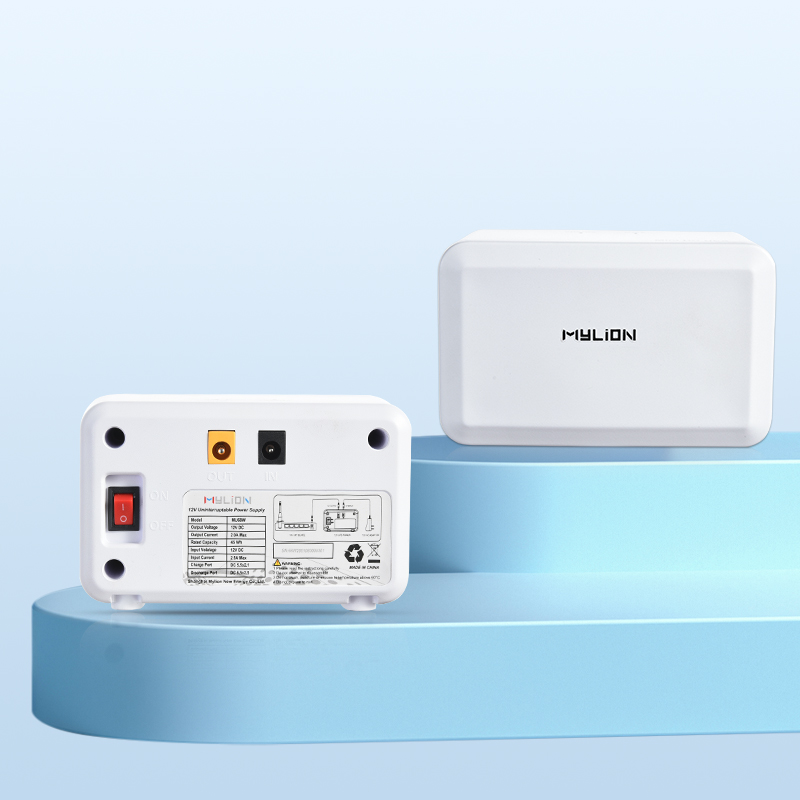
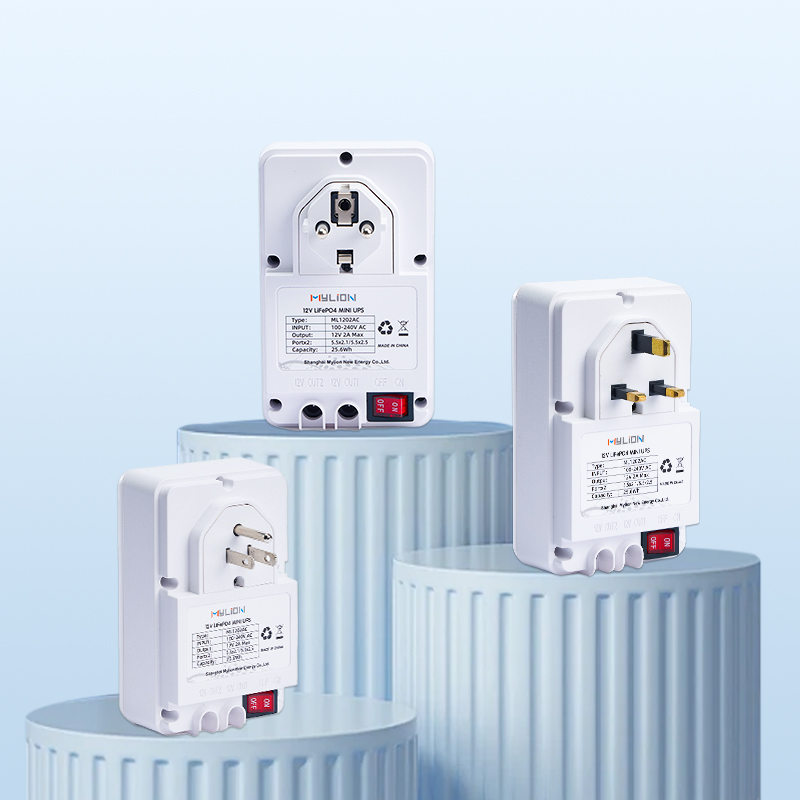
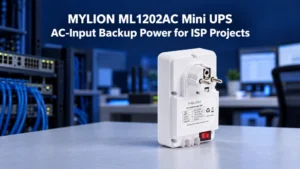
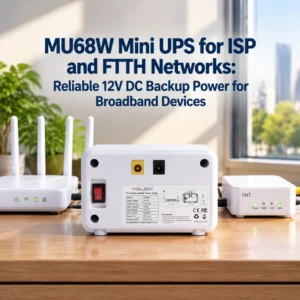
Mylion’s ultra-compact designs – MU68 Mini UPS at 112×70×60 mm or the ML1202 LiFePO₄ Mini UPS series – slide into tight spaces, enabling consistent deployment without cabinet retrofits.
The Right-Sized Solution – Mylion Mini UPS for ISP Edge Backup
Traditional UPS units are overkill for ONTs and routers. They convert AC to DC to charge, then DC back to AC, then the CPE converts to DC again – losing 20–30% efficiency. Mylion Mini DC UPS delivers direct DC output (5V/9V/12V/24V/48V) with >90% efficiency and 0-ms switchover – the ONT never reboots, so customers stay online seamlessly.
Mylion’s product line is built for real ISP workloads:
Mini UPS Series | Current | Best for ISP Use Cases |
MU26 / MU48 | 3A | Basic ONT+router at customer premises (indoor) |
MU68 | 3A (68Wh) | High-reliability home or small business; 9+ hours on low-power ONT |
MU35 / MU65 | 5A | Multi-device (ONT + router + IP camera) |
MUC85 | USB-C PD 65W | Modern USB-C powered CPE / 5G routers |
ML1202AC | 2A LiFePO₄ | Long-life deployments (>2000 cycles) for frequently cycled sites |
MA825 | Waterproof | Outdoor cabinets, rural FTTH nodes, pedestals |
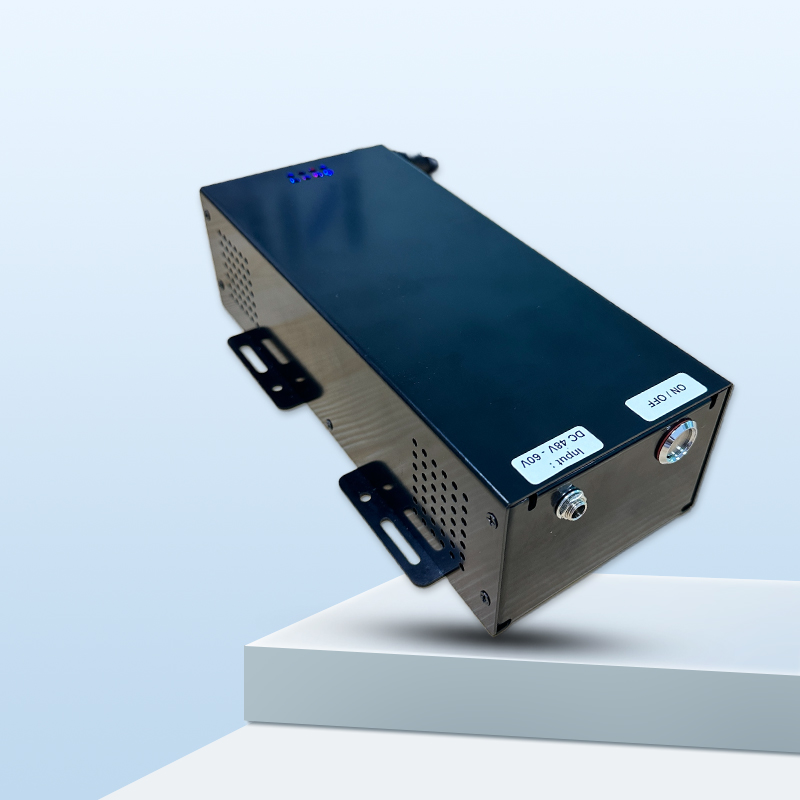
MU248 | 24V/3A + 48V/1A | Telecom base station backhaul, street cabinets |
MUL268 | Solar-ready | Off-grid or remote outdoor sites with solar input |
Every model includes: 0-ms auto switch, multi-voltage output, smart BMS, flame-retardant ABS, and high-temperature operation (45–50°C). OEM/ODM support is available for ISPs needing custom connectors, branding, or specific capacity.
Operational Strategies for ISPs Using Mylion Mini UPS
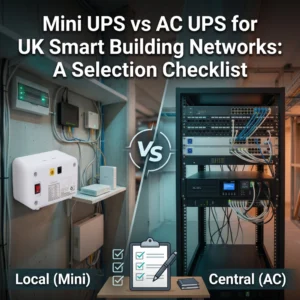
- Tiered backup– Reserve large UPS systems for central OLTs and headends. Deploy Mylion Mini UPS only at the edge (customer ONT, outdoor CPE, small cabinet). This reduces total battery spend by 40–60% while maintaining 99.9% availability.
- Hybrid with generators– For remote base stations or huts, a Mylion Mini UPS (especially MU248 or MUL268) bridges the gap between outage and generator start. Its wide temperature range allows inside generator enclosures or outdoor cabinets.
- Bulk deployment– Mylion offers volume packaging services and provides plug-and-play Mini UPS products for large ISP projects (such as MU26, MU68, and MU35). Field replacement takes under two minutes – unplug old, plug in new.
Selecting the Right Mylion Mini UPS for Your ISP Network
Deployment Scenario | Typical Load | Recommended Mylion | Expected Runtime |
Single ONT (indoor, 2h outages) | 5–7W | MU48 | ~4–6 hours |
ONT + Wi–Fi router (indoor) | 8–12W | MU68 (68Wh) | ~4–5 hours |
ONT + router + camera (SOHO) | 15–20W | MU35 (77.7Wh) | ~3–4 hours |
Outdoor cabinet (rural FTTH) | 10–15W | MA825 (waterproof) | 4–6 hours |
5G CPE with USB–C PD | up to 65W | ~2–3 hours at high load | |
Base station backhaul (24V/48V) | varied | load dependent | |
Off-grid remote node | 10–15W | MUL268 + solar panel | continuous |
Five questions for ISP procurement teams:
- What is your region’s average outage duration? Under 2h → small capacity (MU48/MU68). More than 4h → larger or solar assisted.
- How many customer sites need backup? High volume → prioritize lowest unit cost and compact size (MU68).
- Are outdoor cabinets involved?Yes → MA825 (waterproof) or MUL268 (solar).
- Do you require long battery cycle life (frequent outages)?Yes → ML1202 LiFePO₄ series (>2000 cycles).
- Do you need custom connectors or branding? Mylion supports OEM/ODM – contact engineering for samples.
Mylion provides free load assessment and TCO modeling for ISPs planning large-scale deployments.
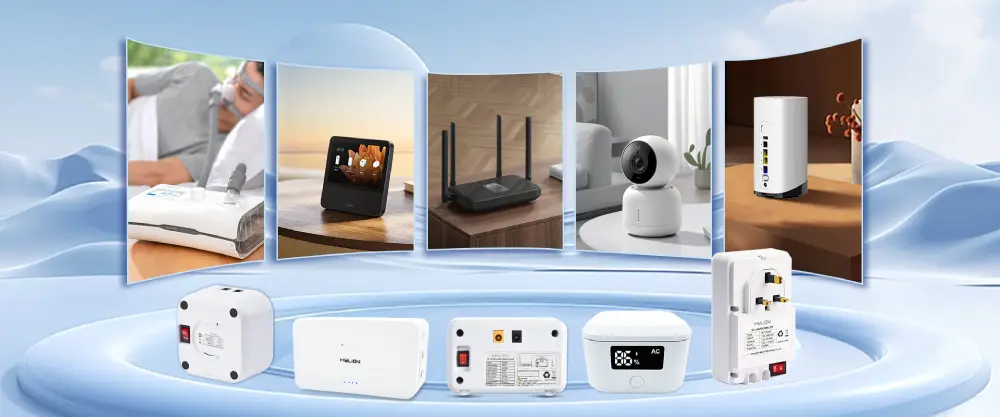
Why ISPs Choose Mylion Mini UPS Over Generic Large Batteries
- Complete ISP-Focused Portfolio– From 2A to 5A, including waterproof, USB-C PD, LiFePO₄, solar-compatible, and dual-voltage models. One vendor covers all edge backup needs.
- Engineering for Real–World Deployment– 0-ms transfer (no router reboot), >90% efficiency, and direct DC output. Designed specifically for low-voltage devices, not repurposed power banks.
- Global Safety Certifications – CE, FCC, UL, IEC62133, UN38.3, RoHS, REACH. Compliant for North America, Europe, Asia, and Australia without customs delays.
- Proven in Demanding Environments– Rated for 45–50°C ambient temperature. Flame-retardant ABS housing and intelligent thermal management. Deployed in outdoor cabinets, dusty warehouses, and high-humidity telecom shelters.
- OEM/ODM & Engineering Support– 12+ years of manufacturing experience. Custom voltages, connectors, capacity, enclosure design, and branding. Fast sample turnaround and stable volume production.
- Global Reach with Local Support– Headquarters in Shanghai, manufacturing in Jiangsu. Sales and logistics covering North America, Europe, and Australia. Quick response and shorter lead times for B2B clients.
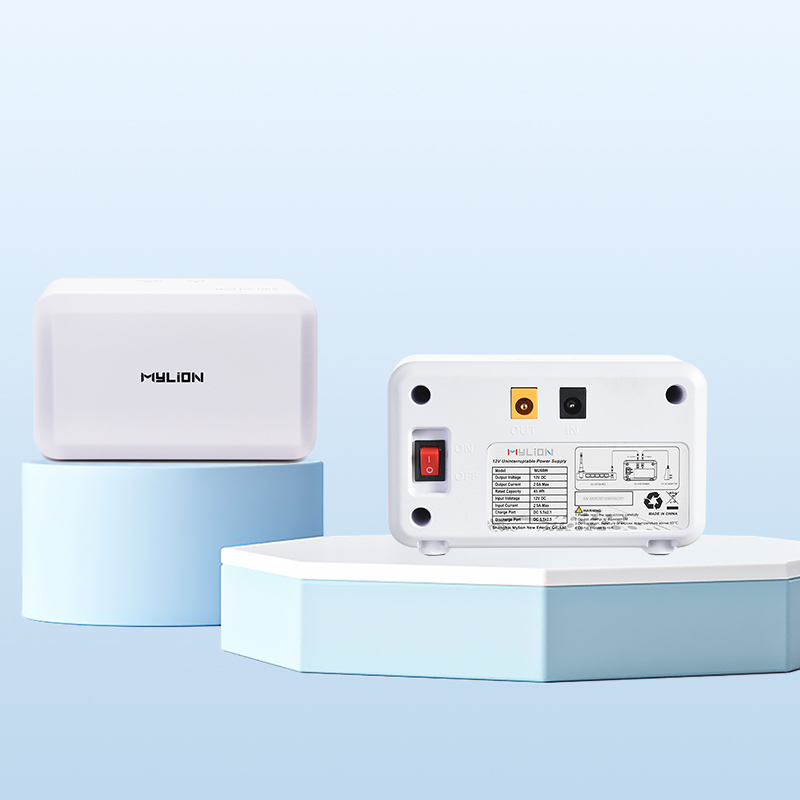

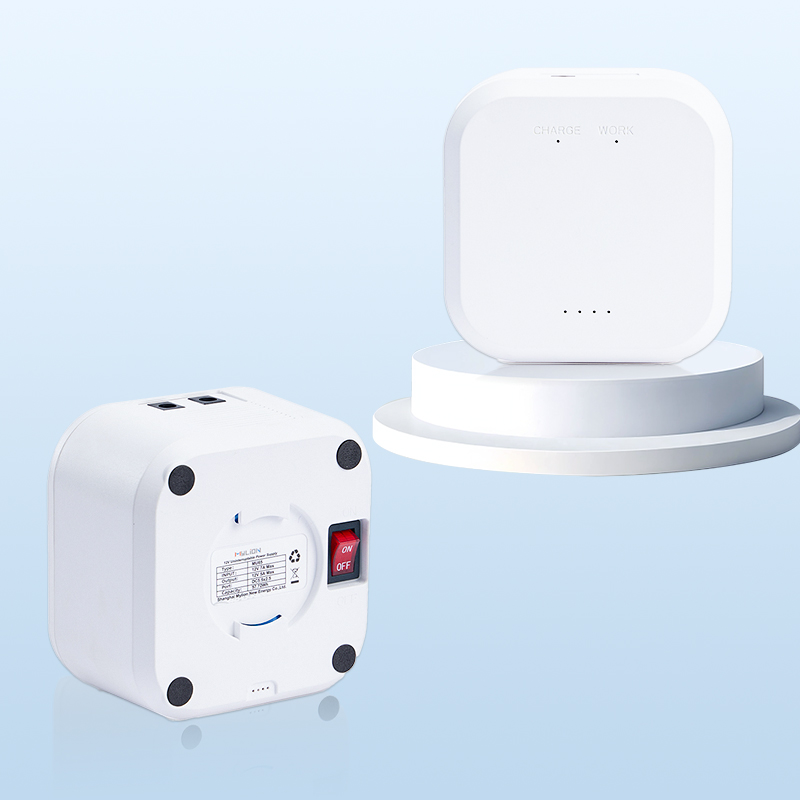
MU26 Mini UPS
MU48 Mini UPS
MU35 Mini UPS
MU68 Mini UPS
LiFePO4 Mini UPS
MU248 Mini UPS
FAQ
Q1: What is the actual runtime of Mylion MU68 on a standard GPON ONT?
Q2: Can Mylion Mini UPS be mounted inside an outdoor pedestal or NID?
Q3: Does Mylion offer volume pricing for ISPs deploying 10,000+ units?
Q4: What is the difference between MU68 (Li-ion) and ML1202 (LiFePO4)?
Q5: Can I get a custom output connector (e.g., 5.5×2.1mm barrel, RJ-11, screw terminal)?
Conclusion
For telecom companies and ISPs, bigger is rarely better when backing up ONTs and routers. Oversized batteries burn CAPEX, complicate logistics, create safety exposure, and often don’t fit in real enclosures. The smarter approach is matching capacity to actual outage patterns and deployment constraints.
Mylion Mini UPS delivers just that a full range of DC backup solutions engineered for the edge of ISP networks. Every model is designed for 0-ms switchover, high efficiency, global safety compliance, and the lowest TCO at scale.
 English
  简体中文
简体中文  Deutsch
  Français
  Italiano
  Español