
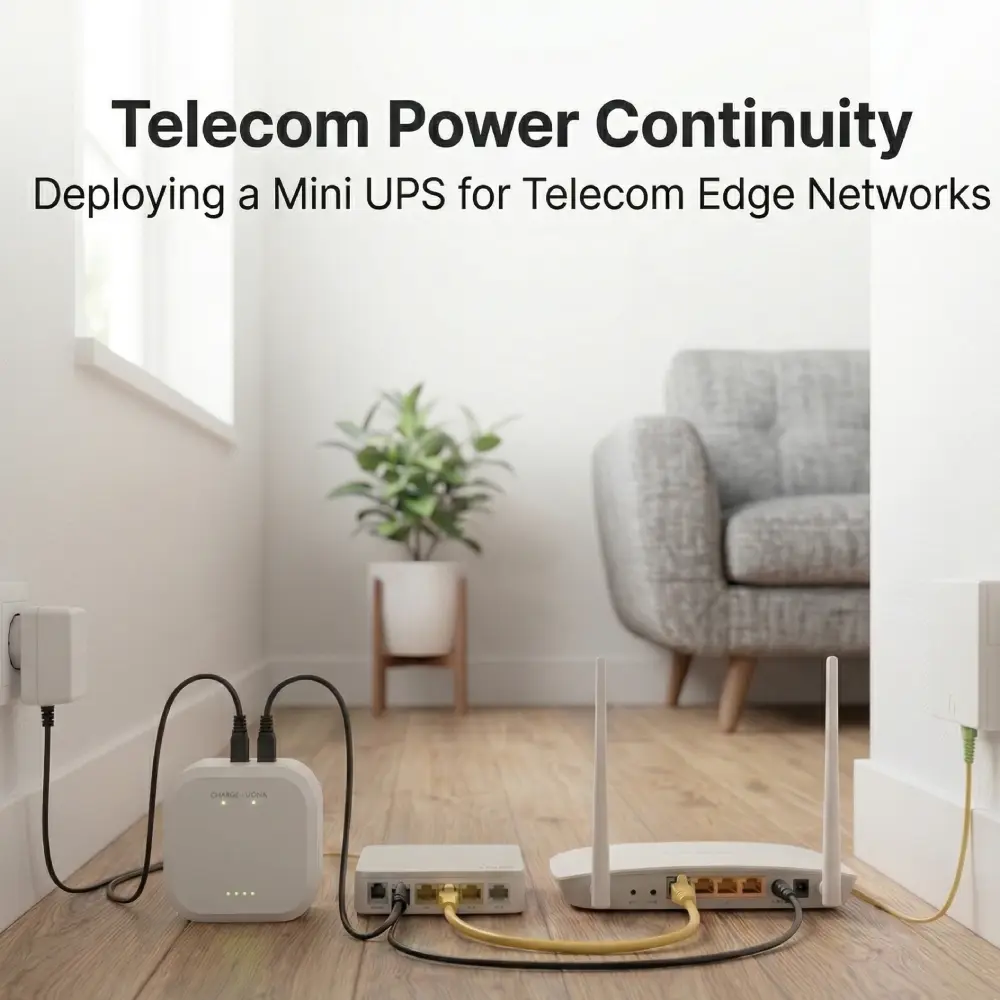
Why Power Continuity is Critical for Edge Networks
In the modern telecom landscape, the network edge has become the primary battleground for customer retention and service reliability. As ISPs and telecom operators push fiber closer to end-users via FTTH and expand 5G deployments, the definition of network resilience has shifted fundamentally.
Power continuity is no longer just about keeping centralized data centers online; it is about ensuring uninterrupted connectivity at highly decentralized nodes and the CPE level. Micro-outages, voltage sags, or grid anomalies can trigger reboots of edge devices such as ONTs, ONUs, and enterprise-grade routers.
Deploying Mini UPS solutions effectively safeguards telecom power continuity. As a trusted manufacturer, Mylion provides a range of tailored Mini DC UPS solutions designed for diverse telecom environments.
The cost of power failure is rising:
- Edge Nodes: From small cell towers and fiber distribution hubs to end-user ONT/ONU devices, a power failure at any node creates a ripple effect across the service area.
- Regional Impact: In Nigeria, 70% of network outages are caused by power shortages (data from MTN Nigeria).
- EU Trends: In 2024, the EU recorded 188 major telecom incidents—a 20.5% year-on-year increase—with power failure cited as the primary cause.
For ISPs and telcos, edge downtime leads to SLA penalties, customer churn, and reputational damage. Power continuity is no longer optional; it is a competitive differentiator.
The Role of Mini UPS in Telecom Applications
A Mini UPS is a compact DC backup power system specifically designed for low-power telecom equipment. Unlike traditional AC UPS units, Mini UPS systems feature:
- Native DC Output:Provides 5V/9V/12V/24V/48V directly, eliminating energy-wasting DC-AC-DC conversion processes.
- Rapid Transfer Time:Switches within 0 to 4ms, preventing device resets and data loss.
- Form Factor:Compact enough for space-constrained street cabinets, customer premises, or pole-mounted enclosures.
- Battery Chemistry:Utilizes Li-ion or LiFePO4 batteries with a lifespan of 8 to 10 years—significantly longer than lead-acid alternatives.
The Mini UPS can convert the unstable power supply from the grid into a reliable and stable operating state required by the edge network, achieving the stable operation level of the enterprise grade.
Power Challenges in the Telecom Edge Network
1. Unstable Grids in Edge Regions
Telecom infrastructure often extends to rural, developing, or geographically complex areas where grid stability cannot be guaranteed. Frequent voltage sags, rolling blackouts, and voltage surges impose significant thermal and electrical stress on standard network adapters and routers.
2. Space Constraints in Edge Deployments
Edge deployment environments—such as telecom cabinets, small cell poles, and subscriber premises—face extreme space limitations.
- Roadside Cabinets:A typical roadside telecom cabinet may offer only a few cubic feet of internal space.
- Rooftop Sites:A rooftop small cell cabinet can be smaller than a suitcase.
- Subscriber Terminals:Wall space behind an ONT at the user end is often highly restricted.
Traditional UPS units are clearly unsuitable for these scenarios. This is why compact, portable, and mountable Mini UPS systems are the ideal solution for achieving power continuity at the edge.
Limitations of Traditional UPS at the Edge
While standard UPS systems perform well in central offices, they exhibit several deficiencies when applied to edge environments:
- Multiple Conversion Losses:Frequent AC-DC-AC conversions reduce efficiency.
- Excessive Capacity:Often oversized for low-power edge devices.
- Lead-Acid Limitations:Bulky batteries with short lifespans.
- Poor Environmental Adaptability:Lack of resilience against harsh outdoor conditions.
Comparison: Mini DC UPS vs. Standard AC UPS
Procurement Metric | Custom Mini DC UPS (Telecom Grade) | Traditional Standard AC UPS |
Power Conversion | Direct DC-DC (High Efficiency ~95%+) | AC-DC-AC-DC (Low Efficiency ~70%) |
Transfer Time | 0ms | 8ms – 20ms (Causes router reboots) |
Battery Chemistry | High-density Li-ion / LiFePO4 | Sealed Lead Acid (SLA) |
Cycle Life | 2000 – 3000+ cycles (3-5 years) | 300 – 500 cycles (1-2 years) |
Footprint | Ultra-compact, mountable, no ventilation needed | Bulky, heavy, occupies floor space |
Maintenance | Zero or low maintenance | High (Regular testing/replacement) |
These restrictions have prompted telecom operators to seek better solutions, namely specially designed Mini UPS systems. Mylion Mini DC UPS is specifically designed for telecom applications.
With advanced battery technology, compact size and high reliability, Mylion Mini UPS provides reliable backup power solutions for indoor, outdoor and remote telecom deployments.

Technical Specifications: What Telcos Must Prioritize
Telecom-grade Mini UPS systems are engineered to eliminate the inefficiencies of legacy backup units. When evaluating deployment options, ISPs and telecom operators must prioritize the following specifications:
- Zero-Millisecond Transfer Time:To prevent equipment reboots, the UPS must feature a true 0ms transfer time. It must switch seamlessly from grid power to battery without the micro-breaks typical of traditional relays.
- Direct DC Output:By bypassing inefficient AC/DC conversions, DC Mini UPS units provide precise voltage matching (e.g., 12V 5A or 9V 3A) directly to network hardware, maximizing energy efficiency and reducing heat output.
- Advanced Battery Chemistry:High-end models utilize Lithium Iron Phosphate (LiFePO4) or advanced Li-ion cells. These offer deeper discharge cycles, higher thermal stability, and longer service life, significantly reducing replacement frequency.
- Compact Design:Given that edge deployment space is often at a premium, the compact form factor of a Mini UPS is essential for space-saving installation in both indoor and outdoor telecom cabinets.
Deploying Mini UPS Systems in the Edge Network
Deploying these systems requires a strategic, phased approach to ensure maximum compatibility. The first step is a rigorous hardware audit of existing edge equipment. Procurement teams must identify the exact voltage and current requirements for their ONTs, CPEs, and routers.
Because off-the-shelf “universal” solutions often fail due to mismatched connector pins or fluctuating output, operators must partner with an OEM Mini UPS manufacturer capable of providing custom port configurations and precise voltage matching. This ensures plug-and-play deployment across thousands of nodes without risking hardware damage or voiding warranties.
Best Practices for Telecom Mini UPS Projects
- FTTH and Smart Home Nodes
Fiber-to-the-home puts ONT/ONU equipment at the extreme edge. Mylion’s MU26 Mini UPS/MU48 Mini UPS/MU68 Mini UPS series features ultra-compact, wall-mountable designs that simplify installation and reduce infrastructure retrofit costs.
- High-Load & Enterprise Deployments
Large-scale deployments require high-efficiency equipment capable of handling sustained loads without micro-reboots. Models like the Mylion MU35, MU05, and MU65 are engineered for these rigorous environments, ensuring seamless DC-to-DC conversion.
- Rural and Off-Grid Remote Sites
In areas with unreliable or non-existent grid power, Mylion systems integrate with renewable energy. The MUL268 Solar Mini UPS is designed for solar-powered cabinets, while the ML1202AC LiFePO4 Mini UPS unit provides long-term stable DC backup.
- Outdoor and Harsh Environments
Outdoor cabinets face rain, dust, and extreme temperatures. Mylion offers the MA825 Mini UPS(Waterproof) and MU248 Mini UPS (Outdoor) models, featuring IP-rated enclosures to defend against water and dust ingress.
- Modern Type-C & High-Power Integration
Next-gen devices are shifting to USB Type-C for power delivery. Mylion’s MUC66 Mini UPS and MUC85 Mini UPS models support Type-C DC output directly, ideal for modern 5G CPE and edge gateways using the USB-PD standard.
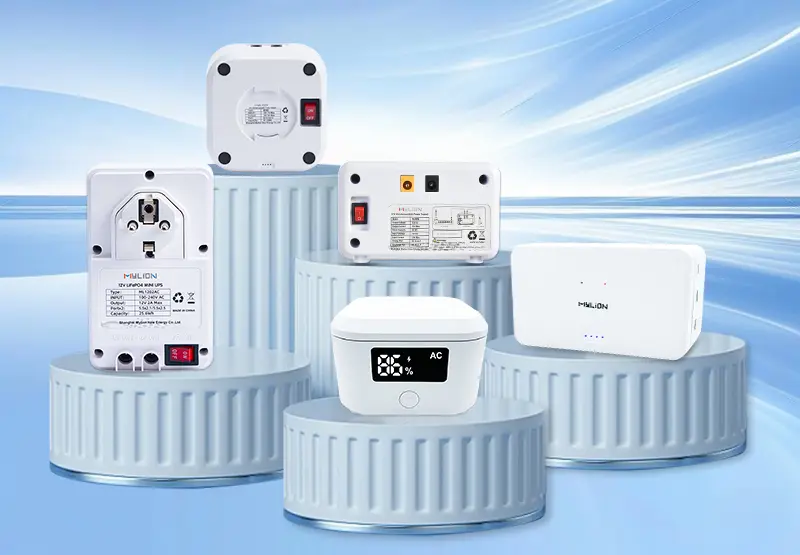
Why Choose Mylion for Telecom Edge Networks
Mylion focuses on solving the core pain points of telecom operators through superior engineering:
- Technical Precision:Delivers stable output (e.g., true 12V 5A) tailored for enterprise networking gear.
- Zero-Millisecond Continuity:Guarantees a flawless transition during outages to eliminate reboots and protect SLAs.
- Deep Customization (OEM/ODM):Provides bespoke port layouts and battery capacities to ensure perfect integration with existing infrastructure.
- Diverse Portfolio:A wide range of models to meet specific project requirements across the telecom spectrum.
FAQ
Q1: What is the impact of 0ms transfer time on telecom equipment?
True 0ms transfer ensures total voltage stability, preventing hardware aging and extending the operational lifespan of network edge devices.
Q2: Can Mylion Mini UPS be customized for specific ISP hardware?
Yes. For large-scale deployments, voltage parameters, connector types, and battery capacities can be deeply customized to match the specifications of specific OEM routers and CPEs.
Q3: Why is LiFePO4 preferred over traditional batteries in edge deployments?
LiFePO4 batteries offer superior thermal stability, making them safer for use in the confined spaces of edge cabinets.
Q4: Are Mini UPS units suitable for outdoor cabinets?
Yes. Mylion provides specific outdoor Mini UPS models and optional IP54/IP65 protective enclosures to withstand harsh environments.
Q5: Do you provide engineering support for large-scale deployments?
Yes. Mylion offers B2B clients pre-sales consultation, sample testing, and post-deployment technical support.
Conclusion
The telecom edge is the cornerstone of modern communication, yet remains highly vulnerable to power disruptions. Mini UPS systems solve these challenges directly by providing high efficiency, zero-transfer switching, and a compact footprint that keeps routers and ONTs online during grid fluctuations.
Mylion offers a comprehensive range of telecom-standard Mini UPS solutions. From FTTH user terminals to remote base stations, our systems ensure your network stays operational. Partner with Mylion to secure power continuity for your next telecom project.
 English
  简体中文
简体中文  Deutsch
  Français
  Italiano
  Español